You walk into the room. Your baby sees you. And stretches.
Arms reaching. Back arching. The whole body going wide open in one long, unhurried motion.
You’ve seen it a hundred times. You probably smiled and moved on.
But what if that stretch isn’t random?
Developmental researchers — including Brazelton, whose work on caregiver-infant reciprocity remains foundational in the field — say it carries more emotional weight than almost any other signal a baby produces. And there are four other behaviors happening in your house right now, every single day, that carry the same weight. Most parents never learn to read them.
Signal 01
The Stretch — A Nervous System Exhaling
Watch it closely. Not the stretch that happens when a baby has been still too long — that one can happen with anyone in the room, or no one at all. Watch for the one that appears in a very specific moment: right when your baby registers your face.
A baby’s nervous system is in a constant state of monitoring — always scanning the environment for one piece of information above all others: am I safe? The primary source of that answer is the face of the person they are most attached to. When you walk in, their nervous system runs a check that happens faster than thought: is this the face I know? Is this the person? When the answer is yes — the body follows.
Research published in PMC confirms this directly: infant heart rates measurably increase during separation from a primary caregiver and decrease on reunion. That settling is not coincidental — it is the body doing exactly what it is biologically designed to do when safety has been restored.
Your baby wasn’t distressed while you were gone. They seemed fine. But their nervous system was tracking your absence the entire time. When you reappeared, the body exhaled. That stretch is their version of exhaling.
“You’re here. Everything is okay.” — spoken entirely through the body, before your baby has a single word.
Signal 02
The Shape of It — Open vs. Curled
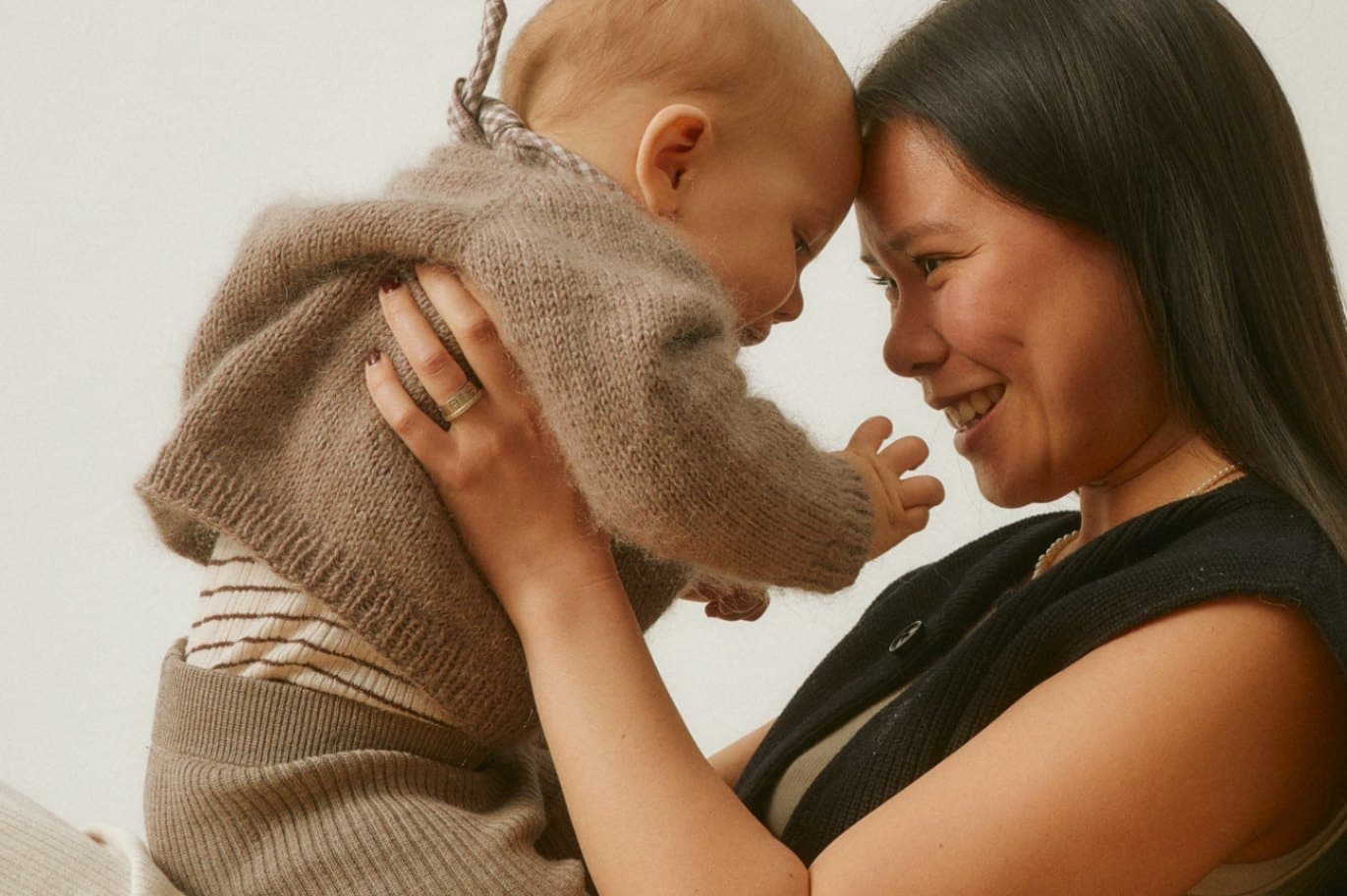
When your baby stretches toward you, the body goes completely open. Arms extend outward. Chest lifts. The whole form goes long and unguarded — like someone waking from genuinely restful sleep, with nothing to protect and nowhere to hide.
Now compare that to what you see when your baby is uncertain, overstimulated, or in the presence of a stranger.
Arms extend outward. Chest lifts. The whole form goes unguarded and wide. This is the body saying: I am not guarded around you.
Shoulders round inward. Arms pull close. The body compresses toward its own center. This is a protective response — the body shielding itself from uncertainty.
John Bowlby, whose attachment theory transformed how we understand the infant-caregiver bond, described this contrast as one of the clearest physical expressions of felt security available in the first year of life. A baby curls toward itself when it does not know if it is safe. A baby opens toward you when it does.
That contrast — curl versus open — is the entire message. You are the reason they know they are safe.
“You are, biologically, a calming system for your baby. Not because of anything you do — because of who you are to them.”
Signal 03
The Settle After — Co-Regulation in Real Time
Watch what happens in the two seconds immediately after the stretch. The body softens. Breathing slows. Whatever brief activation the stretch carried goes quiet again. That settling has a name in developmental research.
A 2024 review by researcher Sam Wass and colleagues, published in the Journal of Child Psychology and Psychiatry, describes co-regulation as a measurable physiological event — not a metaphor. The caregiver’s presence, voice, and sensory familiarity all act on the infant’s autonomic nervous system in real time, regulating arousal, moderating stress hormones, and guiding the body back toward calm. You didn’t touch them. You didn’t speak. You simply appeared — and their nervous system responded.
That response is built from the hundreds of moments that came before this one — the times you appeared when they called, the warmth they have learned to associate with your face and voice, the pattern their nervous system has spent months constructing around your presence.
You are the evidence their body is running on. Every calm reunion is another data point confirming: when this person arrives, I am safe.
Signal 04
The Reach — When a Stretch Becomes a Conversation
In younger babies, the arms go out symmetrically — both sides, no clear direction, just open. But somewhere around three to five months, the stretch begins to change shape. The arms don’t just go outward — they go toward. Toward your face. Toward your voice. Toward the exact point in space where you are standing.
That is no longer a stretch. That is a reach. And it is one of the earliest forms of intentional communication a human being can produce.
Brazelton and colleagues described the moment a baby extends their arms toward a specific caregiver as directed, intentional communication — not reflexive, not random. A 2025 study from Reichman University followed 51 mother-infant pairs through their first year and found that consistently and accurately responding to a baby’s cues — contingent responsive parenting — literally reshapes patterns of brain activity. Babies who received this responsiveness showed calmer fear responses at twelve months and early signs of empathy toward others. Responsive caregiving was identified as the single most powerful protective factor for infant emotional development.
When you respond to that reach — leaning in, mirroring them, picking them up — you are teaching them something that compounds for the rest of their life: when I signal, someone answers. That is the foundation of every relationship they will ever have.
Signal 05
Four More Signals Happening Every Day
These four behaviors belong to the same family as the stretch. They are all the body saying the same thing — in slightly different forms.
A fussing baby who goes silent when they hear your voice — before you’ve touched them, sometimes before you’ve entered the room — is regulating to your presence from a distance. Your voice alone has become a signal that safety is near.
When a baby presses their head into your chest rather than pulling away, that is an active, deliberate choice — not tiredness. Notice they don’t do this with everyone. The lean-in is trust made physical.
Watch their eyes when you move across a room. If they follow you — turning their head, repositioning their whole body to keep you in view — you are, in a room full of interesting things, the most important. That is the stretch expressed through the eyes.
When something unexpected happens, your baby doesn’t react immediately — they look at your face first. Before they decide how to feel. If you look alarmed, they cry. If you stay calm, they often follow. You are their emotional map for all of reality.
The quiet-down, the lean-in, the track, the look-back — all of them are the stretch in different clothing. They are all the body saying: you matter to me. And I am more okay when you are here.
What to Do With All of This
Not a technique. Not a program. One instruction.
Slow down enough to catch it. The stretch. The reach. The look-back. The lean-in. These signals are happening in your house right now — in the background of ordinary life, between the feeds and the naps and the thousand small urgencies of keeping someone alive.
Every time you catch one — every time you see the stretch and lean in, hold the gaze for one extra second, say something soft back, mirror the arms toward them — you are confirming for your baby that their signals work. That reaching out brings someone closer. That the world responds when they speak, before they have any words to speak with.
Researchers call this contingent responsiveness. Each time you show up when they call, the internal question — do my signals matter? will someone come? — gets answered. Each time, toward yes.
You were the answer. You just didn’t know the question.
You walk into the room. Your baby sees you — and stretches. Two seconds. Happens every day. Easy to miss.
But now you know what is actually inside it. A nervous system releasing tension because you arrived. A body going completely unguarded because it feels protected. Recognition. Relief. The earliest form of trust a human being is capable of expressing — before language, before memory, before any conscious understanding of what a relationship even is.