The surprising neuroscience behind your baby’s long, unblinking gaze—and what it means for their development.
There is a baby staring at you. Not glancing, not peeking, but staring—locked on, unblinking, with the kind of focused, unrelenting intensity that would feel unsettling coming from an adult but somehow, from a seven-pound human who cannot yet hold their own head up, feels almost profound. You wave. They keep staring. You make a face. They keep staring. You look away, look back, and they are still there, still watching, as if you are the most important thing they have ever seen in their short, brand-new life.
Most of us laugh it off. We make a joke, do a little dance, maybe feel vaguely judged and move on. But for the last two decades, a small and very determined group of developmental neuroscientists has refused to move on. They wanted to know what is actually happening inside that tiny brain during those long, unblinking stares. And what they found does not just change how you see babies. It changes how you understand human consciousness itself.
The Vision Myth: Why the Simple Explanation Falls Short
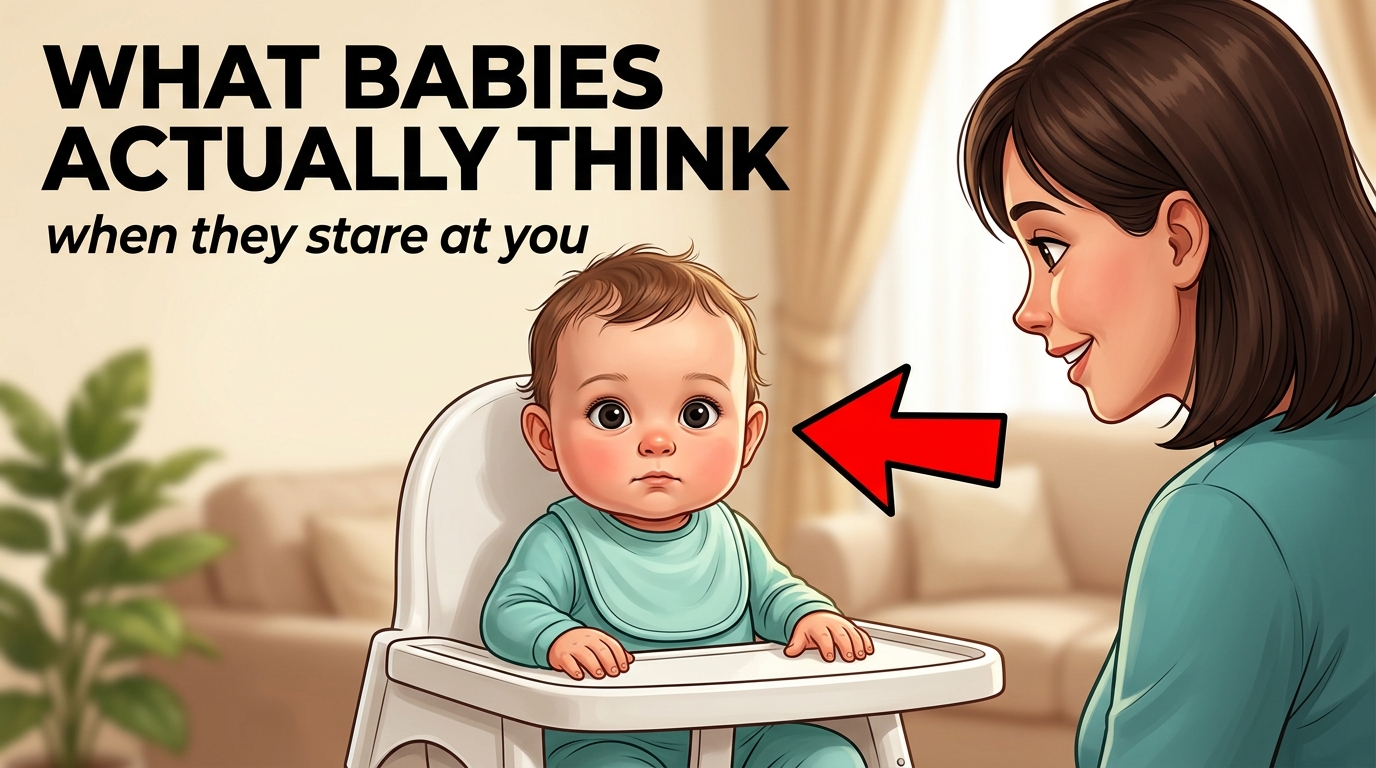
Most parents land on a seemingly logical explanation: babies stare because their vision is poor. Faces are simply the most high-contrast, visually interesting thing in their limited range. Newborns can only see clearly about eight to twelve inches away—roughly the distance from your arms to your face when you are holding them. So of course they stare at faces. There is nothing else they can see clearly enough to focus on.
This theory is clean, logical, and tidy. The problem is that it is almost entirely wrong. By three months of age, a baby’s visual range has expanded enough to take in practically the entire room. The ceiling, the window, the dog, the pile of laundry you have been meaning to deal with for four days. They can see all of it clearly. And they still keep choosing your face. Every single time. That is not blurry vision. That is a preference—a deliberate, consistent, neurologically driven preference for the human face, specifically your face, over every other object in the environment.
The real question is not what babies can see. The question is why they keep choosing you, and what happens in their brains when they do.
Brainwave Synchronization: When Two Minds Connect
When researchers started seriously investigating this question, the data took them somewhere nobody expected. In 2017, a research team at the University of Cambridge’s Baby-LINC Lab published a groundbreaking study in PNAS, one of the most prestigious scientific journals in the world. They were measuring neural activity in both infants and adults during face-to-face interaction, using a technique called functional near-infrared spectroscopy—a way of tracking brainwave patterns in real time without disturbing the natural interaction itself.
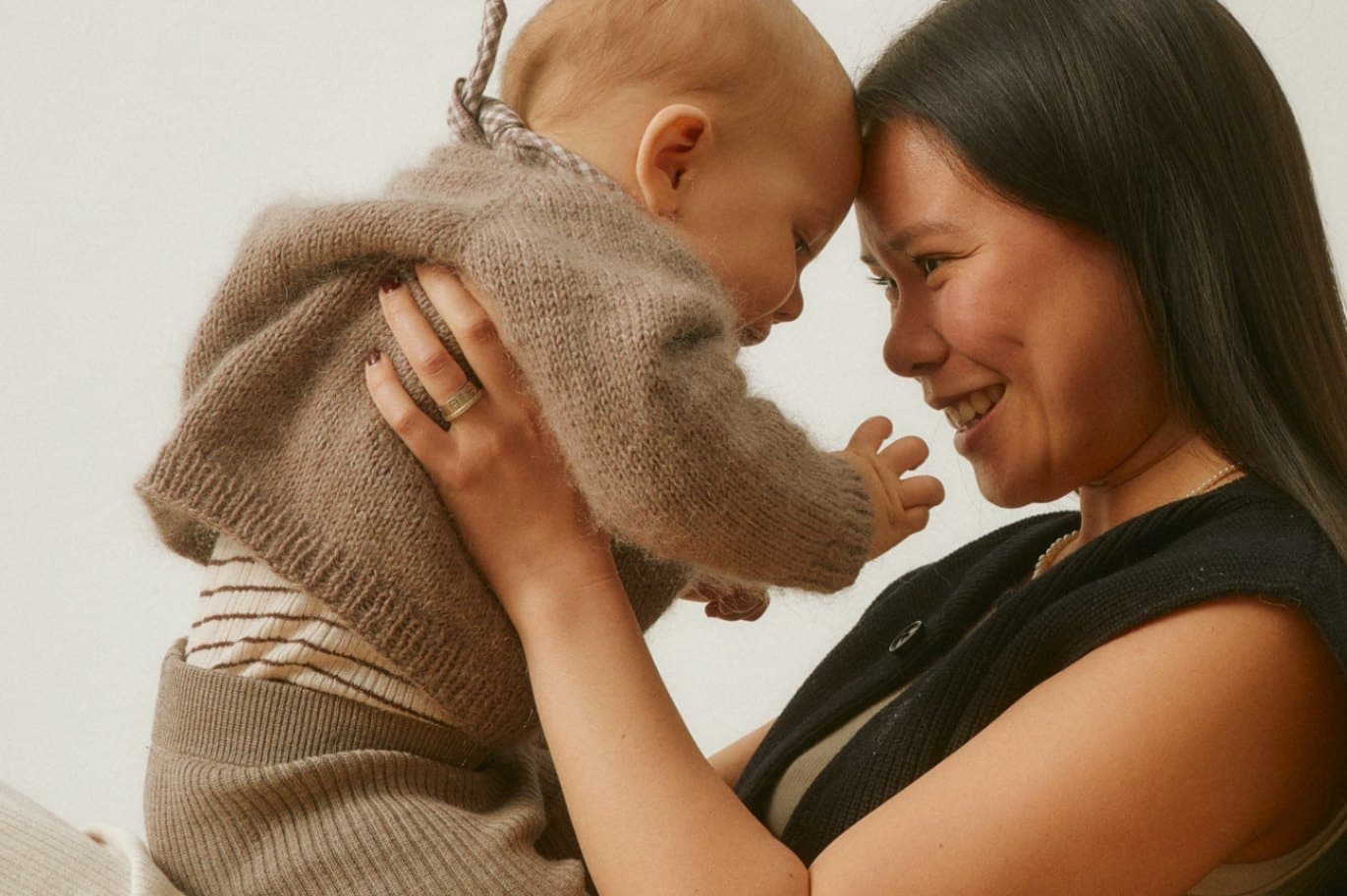
What they were looking for was brainwave synchronization—whether two brains in close proximity might begin to mirror each other’s activity. What they found stopped the field cold. When a baby locks eyes with you, when that intense stare happens, their brainwaves begin to synchronize with yours. The same frequencies, the same rhythms, firing across two completely separate brains simultaneously. The researchers tested every variable. When an adult looks away, synchronization drops. With a neutral face and no eye contact, there is only partial sync. But mutual gaze—true eye contact—produced the strongest neural coupling researchers had ever recorded between two individuals of different ages.
Let that sink in for a moment. Your baby is not just looking at you. They are locking their developing brain onto yours, using your neural activity as a scaffold, a living template for building their own. That long, unblinking stare is not random behavior. It is how human brains teach other human brains how to be human. This is what is happening across the room when a baby catches your eye and will not let go.
Reading Faces: The Sophisticated Science of Social Referencing
But here is where it gets even more fascinating. Babies do not stare at everyone the same way. Researchers at Harvard Medical School ran a deceptively simple experiment. They showed three-month-old infants two faces side by side—a stranger’s face and their primary caregiver’s face. The infants consistently looked longer at the stranger.
This seems backwards at first glance, until you understand the cognitive science behind it. Cognitive scientists call it the violation of expectation response. Babies stare longer at things they have not fully processed yet. The stranger is a puzzle—novel, unread, full of unknowns. But the caregiver’s face? By three months, a baby has already logged thousands of hours of data on that face. Every expression, every micro-movement, every shift in tone between happy and tired and worried and playful. When they look at you—their person—they are not confused. They are reading you, actively and sophisticatedly.
Research published in PubMed confirms that by five months, babies can distinguish between a genuine smile and a performed one. By six months, they are actively tracking your emotional state and using it to decide how to respond to the world around them. Developmental psychologists call this social referencing, and once you understand it, you see it everywhere. You look scared, they freeze. You look excited, they reach for the object. You look calm, they explore. A study from Rasmussen University describes a perfect everyday example: a toddler falls and immediately looks to the caregiver’s face. If the caregiver looks alarmed, the child cries. If the caregiver looks calm and encouraging, the child gets back up. Same fall, completely different emotional outcome—all of it determined by reading your face in that split second.
That long, unblinking stare is not admiration. It is data collection at a level of sophistication we are only beginning to measure. Your baby is building a real-time emotional map of your face and using it to calibrate their own understanding of what is safe, what is dangerous, what is worth exploring, and what should be feared. You are not just their parent. You are their nervous system’s external reference point.
The Still Face Paradigm: What Happens When Connection Breaks
Now you need to understand an experiment that was considered so ethically disturbing it sparked years of debate in developmental psychology. It is called the Still Face Paradigm, designed in 1975 by Dr. Edward Tronick at Harvard. The setup is elegantly simple. A mother interacts naturally with her infant, smiling, talking, responding to every cue. The baby is engaged, animated, staring up at her face with total attention—happy, connected, fully alive in the conversation.
Then, on cue, the mother goes completely blank. Still face, no expression, no response. Eyes open but nothing behind them. What happens next is one of the most studied sequences of infant behavior in all of developmental science. The baby notices immediately. They try to re-engage her—big smiles, pointing, vocalizing, all the things that normally work, none of them working now. They try harder, bigger gestures, more urgent sounds. Still nothing. Within ninety seconds, most infants begin showing measurable physiological stress responses. Cortisol spikes, heart rate rises. Some begin to cry. Others go flat themselves, withdrawing into a kind of emotional shutdown that mirrors the mother’s blankness. When the mother re-engages, recovery is rapid but not instant.
Scientific American’s coverage of Tronick’s decades of research with this paradigm reveals something even more sobering. The still face response in infancy does not just predict distress in the moment. It predicts attachment classification at age one and behavioral outcomes at age three. What Dr. Tronick concluded from twenty years of running this study is this: babies are not passive recipients of care. They are active participants in a constant emotional conversation, and that conversation happens almost entirely through the face. The stare is communication at its most primal, most fundamental level. Your baby is talking to you with their eyes, and they need you to talk back.
Building the Brain: How Face Time Shapes Neural Development
There is one final layer to this story, and it is the one that almost never makes it outside of academic journals. Researchers studying infant visual processing have found that babies who receive more contingent face-to-face interaction in the first six months—meaning interactions where their cues are noticed and responded to—show measurably greater development in the prefrontal cortex. The prefrontal cortex is the part of the brain responsible for planning, decision-making, emotional regulation, and complex social behavior. It is the architecture that runs adult cognition.
Every time you hold their gaze, every time you mirror their expression, every time you respond to what you see in their eyes, you are not just bonding. You are doing construction work on the brain they will use for the rest of their life. This is why the simple act of looking at your baby—really looking, with presence and attention—matters so much for their development. The neural pathways being built during these moments of connection will become the foundation for how your child thinks, feels, regulates their emotions, and relates to others for decades to come.
When to Pay Attention: Signs That May Need Further Evaluation
Because this matters so much, there is something important to address directly. If you notice a baby who does not stare, who consistently avoids eye contact, who does not track your face, who seems to look through you rather than at you, that is not a quirk to wait out idly. Reduced or absent gaze behavior in infancy is one of the earliest observable markers researchers associate with atypical social development. This does not mean something is definitively wrong. Every baby moves on their own timeline, and there is a wide range of normal development. But pediatric neuroscientists are clear on one thing: early identification changes outcomes in ways that later intervention simply cannot replicate.
The brain’s plasticity in the first two years of life is never that high again. The window for optimal intervention is real, and it is time-limited. If something about the stare, or the absence of it, feels off to you, trust that instinct. You have been reading your child’s face since the first hour they were born. You are probably the most finely calibrated instrument in the world for detecting when something has shifted. Talk to your pediatrician. Ask questions. Request evaluation if needed. You are not being dramatic. You are being exactly the parent your child needs you to be.
The Ancient Purpose Behind the Stare
So why do babies stare? Because their brain is reaching for yours. Because your face is the first map they will ever read—the one that teaches them what is safe, what is worth loving, what emotions look like, and how the world responds to them. Because fifteen thousand years of evolution did not give babies those big, round, irresistible eyes by accident. Those eyes are the most sophisticated social interface ever developed by nature.
When one locks onto yours—across a room, across a dinner table, across whatever ordinary moment you happen to be standing in—something ancient and extraordinary is happening. They are learning how to be a person, and they chose your face to learn from. The only right response, the one your biology already knows, the one every instinct in you is already reaching for, is to stare back. Hold their gaze. Mirror their expressions. Respond to what you see. Because in those quiet, ordinary, unblinking moments, you are building something that will last a lifetime.
The next time a baby locks eyes with you and refuses to look away, remember what you now know. That stare is not random. It is not cute coincidence. It is a brain reaching for connection, a nervous system seeking a template, and a consciousness learning what it means to be human. The next time one chooses your face, know that you have been given something remarkable—an invitation to help build a human being, one gaze at a time.