Modern parenting culture has convinced many parents that brain development requires special products and constant stimulation. The research says the opposite. The most powerful brain-building happens in ordinary interactions that cost nothing and need no preparation. Here are ten of them.
The Mirror Game
Builds self-awareness & social intelligence
One of the most fascinating developments in your baby’s first year is the slow realization that they are a separate person — that they have a face, a body, and can control their own expressions. This self-awareness is the foundation for empathy, emotional regulation, and social understanding.
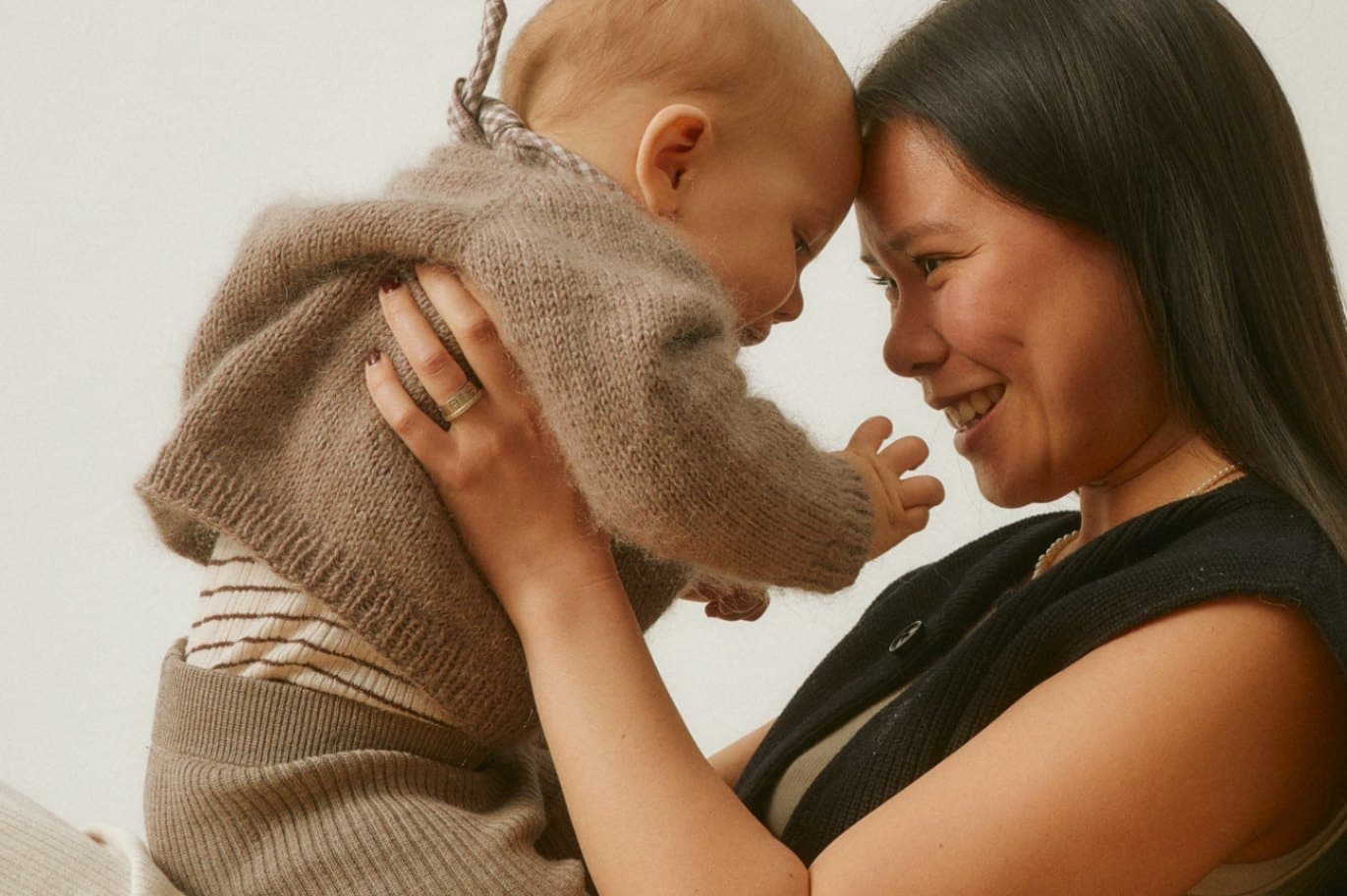
Sit with your baby in front of any mirror and make faces — stick out your tongue, open your mouth wide, raise your eyebrows, smile big. What looks like simple play is wiring neural pathways for self-recognition and what scientists call neural mirroring: the ability to understand what others feel by reading their face and body language.
Use any mirror — bathroom, handheld, even a phone screen. Make expressions, point to your nose then touch theirs, say “that’s you.” Repeat daily. Over weeks, you’ll watch them begin to make faces deliberately, reaching for their own reflection with recognition.
Treasure Basket Exploration
Wires sensory intelligence & scientific thinking
Babies learn about the world primarily through their senses. Every time they grasp a new texture, shake something that makes noise, or explore an object with their mouth, they are building sensory processing pathways that affect everything from reading ability to handling new experiences.
Fill a basket with safe household objects that offer different sensory experiences — a wooden spoon, a metal measuring cup, a soft cloth, a smooth stone, a small cardboard box. Let your baby explore freely without direction. When they discover that the metal cup is cold and heavy, then the cloth is soft and light, their brain is categorizing information, building memory, and learning cause and effect without a single lesson.
Gather 10–15 safe household items with varied textures, weights, and sounds. Avoid plastic — choose wood, metal, fabric, stone. Place them in a basket within reach and step back. Don’t direct. Refresh the objects every couple of weeks to keep curiosity alive.
“The most sophisticated learning tool ever designed doesn’t require batteries or a subscription. It is a handful of sand, a bowl of water, a lump of dough on a Saturday morning.”
The Name Everything Habit
Creates a language explosion
Your baby’s brain is a language-learning machine in the first three years, absorbing vocabulary at an incredible rate even before they can speak a single word. Every word they hear is building neural pathways in the language centers of their brain. Babies who hear rich, varied language early develop larger vocabularies, better reading skills, and stronger communication throughout their entire life.
Every time you hand your baby something, look at something together, or do any activity — name it aloud, clearly and simply. Cup. Water. Blue ball. Warm bottle. You are not testing them. You are planting seeds. For months you may see nothing, but underground the roots are growing. Then seemingly overnight the vocabulary explosion arrives — and it came directly from your words.
Peekaboo Variations
Builds object permanence & logical thinking
Peekaboo is teaching one of the most important cognitive concepts a baby will ever learn: object permanence — the understanding that things continue to exist even when you cannot see them. In early months, when something disappears from view, babies genuinely believe it is gone. Peekaboo teaches their brain, through joyful repetition, that the world is stable and predictable even when parts of it are temporarily out of sight. This is the foundation for all logical thinking that follows.
Play in as many variations as possible — hide behind a blanket, peek around a door, cover a toy with a cloth and let them find it. As they grow, make it more complex. Hide in different places. Let them hide while you search. Each variation builds a different layer of memory and logic.
Music and Rhythm Time
Synchronizes both brain hemispheres
When babies hear music, feel rhythm, and try to clap or move along, they are activating both hemispheres of their brain simultaneously — building connections between areas that control language, movement, emotion, and memory. Research shows early musical experience strengthens mathematical reasoning, language development, and social skills. You do not need formal lessons or instruments. Simple rhythm games are enough.
Clap a simple pattern and encourage them to clap back. Sing songs with hand motions. Give them wooden spoons to bang on pots. Play music and bounce them to the beat. Even imperfect attempts are building those critical cross-hemisphere connections that support every type of learning.
The Crawl Obstacle Course
Boosts brain power through movement
Crawling is one of the most important developmental stages for brain building. The cross-lateral movement of crawling — right arm and left leg, then left arm and right leg — strengthens the connection between the brain’s two hemispheres, which is critical for reading, focus, and all higher-level learning. Adding an obstacle course makes babies problem-solve while moving, building even more neural pathways at once.
Once your baby crawls confidently, create simple courses using pillows, cushions, cardboard boxes, and safe furniture. Crawl through it yourself first to show the path, then let them follow. Change the configuration every few days. Five minutes of this provides developmental benefits that pay off for years.
Reading with Exaggerated Expression
Builds story intelligence & empathy
Reading to your baby is valuable. But how you read matters just as much as how often. Reading with exaggerated expression — different voices for characters, tone that matches emotions, faces that show excitement or sadness — builds auditory processing, emotional understanding, and imagination all at once. Your baby learns that voices carry meaning beyond words, that stories have emotional arcs, and that language can create entire worlds.
Don’t say the words — perform them. If a character is scared, let your voice shake. If something exciting happens, speed up. Use pauses to build anticipation. Read the same books repeatedly — repetition builds strong neural pathways and babies love the predictability of knowing what comes next.
Water Play
Teaches physics through direct experience
Babies are natural scientists, constantly experimenting to understand how the world works. Water play is one of the richest environments for this learning. When your baby pours water from one container to another, they are learning about volume, gravity, and spatial relationships. When they drop objects and see some float while others sink, they are beginning to grasp density and weight. The process of predict, test, observe is the foundation of scientific thinking — and it happens naturally through play that needs no instruction.
Fill a shallow tub with a few inches of water and provide cups, spoons, sponges, and objects that sink and float. Sit with them and let them experiment freely. You can narrate what you see — “the ball floats, the spoon sank” — but don’t try to teach. Let them discover. Bath time works perfectly for this too.
Follow the Leader
Develops memory, imitation & self-control
When babies watch you do something and then try to copy it, they are building neural pathways for memory, motor planning, and theory of mind — the understanding that other people have thoughts and intentions they can learn from. The act of watching, remembering, and then coordinating their body to recreate a movement is actively building the prefrontal cortex: the region responsible for planning, focus, and decision-making.
Sit facing your baby and make simple movements — clap, pat your head, raise your arms, touch your nose. As they improve, add slightly more complex sequences. Celebrate every attempt, not just successes. And sometimes let them lead while you copy — this teaches them that their actions have influence, which builds confidence.
Outdoor Discovery Walks
Nature’s intelligence boost
Nature is one of the most powerful learning environments for a developing brain. Outside, babies are surrounded by multi-sensory information you simply cannot replicate indoors — wind on their skin, birds and rustling leaves, moving clouds, the smell of grass. When you point to a tree, your baby is not just hearing the word. They are seeing its height and movement, feeling the breeze, possibly touching the bark. That rich, layered experience builds connections across multiple brain regions and creates far stronger memory and understanding than any flashcard or video ever could.
Make every walk a discovery walk. Slow down. Point to everything and name it — tree, bird, red car, cloud, dog running. Let them touch grass, feel leaves, watch insects. Describe what you see: “the wind is blowing the branches.” Even 10 minutes outside daily delivers enormous developmental benefits.
Your baby’s brain is not waiting to be stimulated. It is waiting to be met.
Every single one of these activities costs nothing. None require preparation. All of them can start today.
The ordinary moments — the mirror game before breakfast, the treasure basket on the kitchen floor, the peekaboo before naptime, the discovery walk around the block — these are not filler between the important parts of the day. They are the important parts of the day.
The brain being built right now, in these small joyful interactions, is the one your child will carry for the rest of their life.
🧺 Treasure Basket
🗣️ Name Everything
👋 Peekaboo
🎵 Music & Rhythm
🏃 Obstacle Course
📖 Expressive Reading
💧 Water Play
🙌 Follow the Leader
🌿 Discovery Walks